sexta-feira, 7 de junho de 2019

Texto para Aqueles que Tentam Salvar Papa Francisco


Dan Hitchens, editor de um dos maiores jornais católicos do mundo, o The Catholic Herald, escreveu um artigo para aqueles que tentam tornar o Papa Francisco em um papa verdadeiramente católico.

O artigo foi escrito para a First Things, talvez a revista católica de maior prestígio nos Estados Unidos.

Hitchens basicamente tem três recados àqueles que tentam provar a cada frase herética do Papa Francisco que 'na verdade" a frase é pura ortodoxia católica:

Primeiro recado:  Qualquer frase herética pode ser transformada em frase ortodoxa se você se esforçar o bastante. Por exemplo, se alguém diz que Cristo não é filho de Deus, basta você distorcer o que significa filho. Hitchens usa duas frases que Francisco realmente disse para provar seu ponto.

Segundo recado:  Olhem os terríveis efeitos das confusões de Francisco entre os fiéis. Com Francisco, os católicos estão desorientados, não sabem mais o valor católico da Eucaristia nem do casamento, não sabem mais o que é inferno, nem o que a Igreja tem a dizer sobre contracepção, nem se a Igreja apoia ou não a pena de morte.

Terceiro recado: Quando confrontado com suas ações e palavras o Papa Francisco agora deu para dizer que não se lembra.

Aqui vai parte do texto de Hirchens:

Pope Francis Forgets
by Dan Hitchens
6.7.2019

Did Pope Francis know? Was he told, five years before the world found out, that the powerful Cardinal McCarrick was a serial sexual abuser? The diplomat who claims to have informed the pope, Archbishop Carlo Maria Viganò, names two dates on which he raised the matter with Francis: June 23 and October 10, 2013. But the Holy Father, in a new interview with Valentina Alazraki, says he simply can’t remember. “When [Viganò] says he spoke to me that day, he came ... I do not remember if he told me about this. If it is true or not. No idea.”
This is not the only gap in the papal memory. Alazraki asked Francis about a February speech that described persistent critics of the Church as “relatives of the devil.” The pope replied: “I do not remember the text but no, no. I do not feel that way.” What about the headline-making 2014 phone call in which the pope allegedly encouraged a woman to ignore Church teaching on Communion and divorce? Also a blank: “What I said to that woman I do not remember.”
Francis is also unsure about his famously ambiguous footnote on Communion for those in “irregular relationships”: “I don’t remember the footnote,” he told the press in 2016. The Holy Father is an eighty-two-year-old man with a lot on his plate. But the impression of all these forgettings is—and it hurts to say this—of a teacher who often speaks without much reflection, before or after. While that may not be the greatest of imperfections, in a pope it can be catastrophic.
Because of those forgotten statements about Communion, dioceses and even a national bishops’ conference have permitted Communion for the sexually-active divorced and remarried. In so doing, they have discarded the teaching of Jesus Christ about marriage, the EucharistConfession, and divine grace, and endangered many souls. At the parish level, the evidence is necessarily more anecdotal, but it is disturbing enough. From Normandy to northern Argentina, the pope’s words are treated as a green light for Communion for the remarried. Eric Sammons, who spent five years as director of evangelization for the Diocese of Venice in Florida, saw widespread confusion on this and other matters. “I saw Catholics engaged in adultery receive Holy Communion... ‘because Pope Francis.’ I saw Catholics assert that it was wrong to evangelize... ‘because Pope Francis.’ I saw Catholics denigrate big families... ‘because Pope Francis.’” Such stories are common.
...
For years I used to tell myself and others that Francis had been misread by intemperate bloggers and ignorant reporters. But the more you do this, the more you start to realize two things.
First, that practically any statement can be reconciled with Church teaching, if you try hard enough. Give me a minute, and I can probably explain why a papal remark such as “States must be secular” or (of some cohabiting couples) “they have the grace of a real marriage” can be given an orthodox interpretation. Indeed—to move from real examples into a thought experiment—“Jesus Christ is not the son of God” could be given an orthodox interpretation if you really want one. (It all depends on the meaning of “son”…)
But the mere possibility of an orthodox reading is not the only thing that matters. This is the second thing you realize: It also matters whether the words mislead people. And the pope’s words—combined with his actions and his conspicuous silences—are frequently, needlessly, seriously misleading about Catholic doctrine. Some of the most glaring examples relate to contraceptionhell, and the theoretical legitimacy of the death penalty, but the list grows practically every month.
The Vatican’s liturgy chief, Cardinal Robert Sarah, recently observed: “Every day I receive calls for help from everywhere from those who no longer know what they are to believe. Every day in Rome, I receive discouraged and suffering priests. The Church is going through the dark night.” Cardinal Sarah points the finger at “high-ranking prelates” rather than the pope himself. Nevertheless, his image will resonate with the many Catholics who feel that darkness has descended on the Church, and that they can scarcely see more than a few steps ahead.
Now, what you are meant to do in a dark night, if I have understood the spiritual writers correctly, is to persevere. To resist the temptations—to anger, to despair, to rash actions, to apostasy—which may press upon you. To keep to your ordinary duties, and hand on Christ’s teaching to others. To pray and offer up your sufferings, not least for any churchmen who have challenged your faith. And to remember the Church’s previous crises—including the darkest of dark nights, many centuries ago, when hope itself seemed utterly dead and buried.

quarta-feira, 5 de junho de 2019

30 Anos do Massacre na Praça Tiananmen em Beijing. Chineses Não Lembram.


Reportagem da CBS acima mostra que os chineses não sabem o que aconteceu no dia 4 de junho de 1989, mesmo mostrando a foto mais conhecida do protesto dos chineses contra a ditadura (foto abaixo). Analistas dizem que milhares foram mortos pela ditadura por conta dos protestos. A reportagem entrevista um sobrevivente que mora nos Estados Unidos e ele diz que até hoje não pode voltar para a China nem seus familiares podem sair de lá.


Terrível ditadura chinesa, que muitos no Brasil e no mundo elogiam.


Papa Paulo VI, Jacques Maritain e Saul Alinsky


Desde o lançamento, ando lendo os comentários feitos sobre o livro nos Estados Unidos, além de uma entrevista que o próprio Marshall deu sobre o livro em que rebate algumas críticas.

Sobre o livro, conheço o Dr. Marshall há algum tempo, sei que ele conhece muito a Igreja e sua história. Discordo dele sobre o pensamento que ele tem sobre economia e catolicismo (mais essa não é área de especialização dele) e também discordo dele sobre a atitude que se deve ter em relação ao Papa Francisco (ele considera que o Papa é terrível, mas não defende que o Papa Francisco seja herético, pelo menos não defende isso abertamente).

Mas eu estava lendo uma avaliação do livro feita pelo Padre John Todd Zuhlsdorf (no seu blog Father Z).

Lá no fim do texto, o padre Z diz: "você sabia que o Papa Paulo VI se encontrou três vezes com Saul Alinsky? E que Jacques Maritain era um entusiasta do pensamento de Saul Alinsky? E que Alinsky era um entusiasta do pensamento do Paulo VI?"

O quê? Como?

Caramba, não sabia disso. Saul Alinsky foi uma marxista radical que queria conquistar a sociedade cristã por dentro, por meio de organização de comunidades. Alinsky dedicou seu livro mais famoso (Regras para Radical)  a Lúcifer, por representar a rebeldia contra o domínio. Fico agora sabendo que  o próprio Jacquers Maritain pediu que Alisnky fizesse esse livro.  Perguntado se preferia o Inferno ou o Paraíso, Alinsky respondeu que preferia ir para o Inferno. Barack Obama é fã de Alinsky, assim como Hillary Clinton.

Daí descobri um artigo do The Remnant sobre Paulo VI, Jacques Maritain e Saul Alinsky, escrito por Christopher Ferrara. Gosto muito dos textos de Ferrara, mais até do que os textos de Marshall.

Aqui vai parte do texto de Ferrara sobre esse relacionamento terrível da Igreja com Alinsky:

Saul Alinsky and "Saint" Pope Paul VI: Genesis of the Conciliar Surrender to the World Featured

Written by  
This article, adapted from a presentation given at the 2018 symposium of the Roman Forum at Lake Garda, examines the origin of the current unparalleled crisis in the Church at its origin: the neo-Modernist uprising during the Interwar Period, culminating in that catastrophe known as the “opening to the world” at Vatican II.
The conciliar “opening to the world” was assisted mightily by two deluded “conservative” visionaries whose roles were absolutely decisive: Jacques Maritain and his disciple Pope Montini, whose relationship and mutual connection to none other than Saul Alinksy are the focus of this piece.
It is no longer possible to deny in good faith that the Council’s outcome has been the spread of an ecclesial disease that now affects virtually every region of the Mystical Body, and which both Maritain and Montini loudly deplored in its earliest stages while resolutely refusing to acknowledge their own role, and that of the Council, in the growing debacle.
For more than fifty years, traditionalist commentators, remarking the obvious, have chronicled the resulting ecclesial decline in every department. They have warned unceasingly that the reformist mania the Council unleashed—to the applause of both Maritain and Montini and their fellow deluded “conservative” reformers—would end in final disaster for the human element of the Church. Final disaster has arrived with the out-of-control papacy of Jorge Mario Bergoglio and his circle of homosexual and homosexual-enabling collaborators, whom he has systematically elevated to positions of power in service to his veritable dictatorship over the Church.
...
While he lived to regret the ecclesial ruin he had provoked and then sought desperately to repair—too little, too late—Pope Montini was a revolutionary who had been formed by the “conservative” Modernism of another revolutionary: Jacques Maritain. As Montini famously admitted: “I am a disciple of Maritain. I will call him my teacher.”Maritain’s Integral Humanism (1936) was nothing less than the “‘petit livre rouge’ (‘little red book’) of a whole generation of Christians.” That is, liberal Catholics like Montini, the child of haute bourgeois “patriots” of the Italian state created by the revolutionary violence of the so-called Risorgimento.Like Maritain himself, Montini was seduced by the ignis fatuus of a New Age of humanity in which the Church, happily reconciled to pluralist democracy and the modern conception of rights, would be the leaven of a New Christendom, free from the disabling structures of what Maritain dismissed as the surpassed “sacral age” of medieval Christendom to which there could never be a return in any form. Montini and Maritain were typical of the false prophets of modernity who could not see, even as it was happening, what the pre-conciliar Popes readily predicted would happen were the Church ever to accommodate her teaching to the spirit of the age with its non-negotiable demand for the extinction of the Catholic confessional state.
The “First Modern Pope,”the deluded disciple of a deluded layman, would lead the Church on a disastrous deviation from the path of all his predecessors, only to be “confronted with the shattered assumptions of his whole pontificate.”[4] In his The Peasant of the Garrone, published in 1966, Maritain joined Montini in lamenting the aftermath of the Second Vatican Council while absolving it of any blame for the post-conciliar neo-Modernist uprising he deplored even though his own “thought,” which had spawned an international cult of Maritainismo to which Montini belonged, was instrumental in facilitating that uprising during and after the Council.
Maritain and Alinsky
In Peasant, Maritain writes of his own relationship to a fellow revolutionary, Saul Alinsky:I see in the Western world no more than three revolutionaries worthy of the name—Eduardo Frei in Chile, Saul Alinsky in America, ... and myself in France, who am not worth beans, since my call as a philosopher has obliterated my possibilities as an agitator…. Saul Alinsky, who is a great friend of mine, is a courageous and admirably staunch organizer of “people’s communities” and an anti-racist leader whose methods are as effective as they are unorthodox.
Inexplicably enough, Maritain was infatuated with the cigar-chomping, Jewish agnostic community organizer, whom he first met in 1945 during his wartime and post-war sojourn in America. The Maritain scholar Bernard Doering notes that whenever Maritain and Alinsky met, they “spent long hours exploring the democratic dream of people working out their own destiny. Both accepted democracy as the best form of government.”
Alinsky’s vaunted career as a social justice warrior in Chicago, where he developed deep connections with the progressive priests and prelates of the Chicago archdiocese, produced little or nothing in the way of actual justice. But, at the urging of none other than Maritain, he did produce a couple of influential books on how to be an effective rabble-rouser and political dirty trickster in the promotion of socialist causes. From “the very first days of their friendship in wartime America,” Doering writes, “Maritain had been urging, indeed relentlessly prodding, Alinsky to publish an explanation of his methods of community organization, a kind of handbook for authentic revolution.”
Alinsky wrote his Reveille for Radicals specifically at Maritain’s request, and Alinsky gave him the exclusive rights to the French translation. In a letter of recommendation for a foundation grant to Alinsky, Maritain described him as “practical Thomist”—an example of just how elastic was Maritain’s so-called Thomism. In the same letter, he described Alinsky as “a great soul, a man of profound moral purity…”
It was Maritain who also urged publication of Alinsky’s last work, the infamous Rules for Radicals (1971), which would influence the careers of both Barack Obama and Hillary Clinton. Apparently, Maritain either failed to read or decided to overlook much of the content of the book whose publication he would later laud.
Rules is dedicated to “the first radical known to man who rebelled against the establishment and did it so effectively that he at least won his own kingdom—Lucifer.” In Rules, Alinsky declares: “Dogma is the enemy of human freedom. Dogma must be watched for and apprehended at every turn and twist of the revolutionary movement.” He then immediately contradicts himself by laying down one dogma after another, including:
1) The “sacred right” to revolution.
2) The dictum that “Mankind has been and is divided into three parts: the Haves, the Have-Nots, and the Have-a-Little, Want Mores.” “The spiritual life of the Haves,” quoth Alinsky, is merely “a ritualistic justification of their possessions.”
3) Various ethical rules for the social justice warrior, including the right to employ blackmail other immoral means if really necessary to achieve a so-called social justice end.[9]
According to Alinsky’s ethical rules “the real and only question regarding the ethics of means and ends is, and always has been, ‘Does this particular end justify this particular means?’” “Ethical standards,” says Alinsky, “must be elastic to stretch with the times.” “To say that corrupt means corrupt the ends is to believe in the immaculate conception of ends and principles,” he further declared.
Alinsky even quotes Maritain—unfairly and out of context—to support his claim that SJW’s who will not fight dirty have “fear of soiling ourselves by entering the context of history is not virtue, but a way of escaping virtue.” Ethical judgments, says Alinsky, “must be made in the context of the times in which the action occurred and not from any other chronological vantage point,” and “the less important the end to be desired, the more one can afford to engage in ethical evaluations of means.”
...
This was written at the same time neo-Modernist opposition to the Church’s teaching on marriage and procreation was impelling Montini to produce the document that became Humanae Vitae. In spite of all this, Maritain wrote to his beloved friend Alinsky in 1971, one of his last letters, to praise Rules as:
“A great book, admirably free, absolutely fearless, radically revolutionary…. I regard the book as history-making. If middle-class people can be organized and develop a sense of and a will for the common good—and if Saul is there to inspire them—they are able to change the whole social scene for the sake of freedom.”
After a few timid objections to Alinsky’s amoral situation and utilitarian ethics, for which he apologizes, Maritain concludes his dithyrambic epistle to the agnostic Jewish agitator: “You know that I am with you with all my heart and soul. Pray for me, Saul. And God bless you. To you, the fervent admiration and abiding love of your old Jacques.[13]
In an interview with Playboy Magazine very shortly before his death from a heart attack in 1972 at the age of 63, which interview is part of a declassified FBI file, the man Maritain asked to pray for him declared that he would unhesitatingly choose hell over heaven:
PLAYBOY: Having accepted your own mortality, do ·you believe in any kind of afterlife?
ALINSKY: Sometimes it seems to me that the question people should ask is not “is there life after death?” but “Is there life after birth?” I don't know whether there’s anything after this or not. I haven’t seen the evidence one way or the other and I don't think anybody else has either. But I do know that man’s obsession with the question comes out of his stubborn refusal to face up to his own mortality. Let’s say that if there is an afterlife, and I have anything to say about it, I will unreservedly choose to go to hell. 
PLAYBOY: Why?
ALINSKY: Hell would be heaven for me. All my life I’ve been with the have-nots. Over here, if you’re a have-not, you’re short of dough. If you’re a have-not in hell, you’re short of virtue. Once I get into hell, I’ll start organizing the have-nots over there. 
PLAYBOY: Why them? 
ALINSKYThey’re my kind of people

Alinsky and Montini


The 30-year-long intimate friendship between “old Jacques” and Alinsky gave rise to a connection between Alinsky and Maritain’s foremost disciple, the future Pope Paul VI. Montini was then Archbishop of Milan, to which post he had been sent off without being made a cardinal after Pius XII lost confidence in him on account of his Modernist tendencies.
In his study The Radical Vision of Saul Alinsky, P. David Finks notes that “For years Jacques Maritain had spoken approvingly to Montini of the democratic community organizations built by Saul Alinsky.” Accordingly, in 1958 Maritain arranged for a series of meetings between Alinsky and Archbishop Montini in Milan. Before the meetings, Maritain had written to Alinsky to tell him that, as Finks recounts: “the new cardinal was reading Saul’s books and would contact him soon.”
There were three meetings between Montini and Alinsky in Milan during the late spring of 1958.
On June 20, 1958, Alinsky wrote to Maritain: “I had three wonderful meetings with Montini and I am sure that you have heard from him since.” Among the subjects discussed, according to Nicholas Hoffman, was how to counter rising Communist influence in the industrial north of Italy without “reinforcing reactionary elements that had less interest in democracy than in squelching the working man.”In other words, the old liberal game of using the threat of one political trap to drive the people into the jaws of another: oppose communism with soft socialism, just as socialism had been opposed by the Party of Order in France. And, in fact, soft socialism became Italian policy under the Moro government elected in an alliance with the Socialists in 1963.
We will never know what exactly passed between Montini and Alinsky during those “three wonderful meetings” in Milan, but we do know that upon his return to Chicago from Italy, Alinsky wrote as follows to George Shuster, two days before the papal conclave that elected John XXIII: “No, I don’t know who the next Pope will be, but if it’s to be Montini, the drinks will be on me for years to come.”
What did Alinsky know? What did he learn from his “three wonderful meetings” with the man who was soon to become the First Modern Pope? He learned what Maritain already knew about his disciple: that if and when Montini became Pope, there would be a revolution in the Church.
And so there was. It was Pope Montini who would declare after the Council on the pages of L’Osservatore Romano (July 3, 1974): “The important words of the Council are newness and updating… the word newness has been given to us as an order, as a program.”Never in Church history had a Pope uttered such nonsense in a public address to the Church universal.
...
Conclusion: The Bitter Harvest of a Revolutionary Fellowship
The relationship between Maritain, Montini and Alinsky was an early reflection of the de facto fusion of the human element of the Church with the world—the “temporalization of Christianity” Maritain was forced to recognize—that has since characterized the post-conciliar crisis as a whole. Thus was the New York Times able to observe early in the Bergoglian pontificate that none other than Barack Obama had “fit seamlessly into a 1980s Catholic cityscape forged by the spirit of Vatican II, the influence of liberation theology and the progressivism of Cardinal Joseph L. Bernardin, the archbishop of Chicago, who called for a ‘consistent ethic of life’ that wove life and social justice into a ‘seamless garment.’”
The Times notes that Obama, the young community organizer in Chicago’s progressive Catholic environment, which Saul Alinsky was instrumental in creating, was mentored by Gregory Galluzzo, “a former Jesuit priest and disciple of the organizer Saul Alinsky.” Obama even “had a small office with two cloudy glass-block windows on the ground floor of Holy Rosary, a handsome red brick parish on the South Side, where he would pop down the hall to the office of the Rev. William Stenzel, raise a phantom cigarette to his lips and ask, ‘Want to go out for lunch?’”.
As the Times further observes, while operating on a grant from the Archdiocese of Chicago, “Obama became a familiar face in South Side black parishes. At Holy Angels Church, considered a center of black Catholic life, he talked to the pastor and the pastor’s adopted son about finding families willing to adopt troubled children. At Our Lady of the Gardens, he attended peace and black history Masses and conferred with the Rev. Dominic Carmon on programs to battle unemployment and violence. At the neo-Gothic St. Sabina, he struck up a friendship with the Rev. Michael L. Pfleger, the firebrand [i.e., ultra-Modernist dissenter from doctrine and dogma] white pastor of one of the city’s largest black parishes.”
As a Senator in the Illinois State Senate, Obama, the social justice warrior from Alinsky’s Chicago and Bernadin’s corrupt, homosexual-infested Archdiocese, would refuse to support the Born Alive Protection Act, presented to the state legislature when it was revealed that the survivors of late-term induced abortions in Chicago hospitals were being left to die after delivery.[29] As President of the United States he would defend “partial birth abortion,” the compulsory subsidy of contraception by Catholic nuns, and federal “guidelines” for “transgender bathrooms” in public schools. And today, the Catholic bishops of America, most of whom probably voted for Obama, are united in the conviction that Donald Trump, usurper of the New World Order, must be stopped.
Behold the last and bitter harvest of a revolutionary fellowship between Catholic churchmen and the world, exampled early on by the link between Jacques Maritain, Saul Alinsky and “the First Modern Pope.”


segunda-feira, 3 de junho de 2019

O Islã Pode ser Derrotado?


Ontem, eu soube que a freira espanhola Ines Nieves Sancho foi decapitada por terroristas islâmicos na República Centro-Africana. O grupo terrorista se autodenomina 3R (tirado do francês, Retorno, Reclamação, Restauração) e diz representar os jihadista Fulâni. Desde a queda do presidente cristão François Bozizé, já foram tentados 14 acordos de paz com os diversos grupos terroristas que assolam o país, e não houve resultado. O país já deu territórios e imunidade aos terroristas e nada.

Por que será que o tal "diálogo" com terroristas não funciona?

Bom, enquanto não se desejar entender que o Islã deve ser derrotado não haverá paz.

Hoje, eu li um texto muito bom escrito por um saudita que é Ph.D em Novo Testamento pela Universidade de Durham na Inglaterra.

Ele responde a duas perguntas: Por que o Islã consegue converter pessoas no Ocidente? e O Islã Pode ser Derrotado?

É um texto muito bom porque o autor, Matteen Elass, tem ótimo conhecimento do Islã e também do cristianismo. Além de conhecer a Arábia Saudita e o Ocidente.

A experiência que ele teve ao visitar as "igrejas" na Inglaterra, eu vi de perto quando morei lá. As "igrejas" viraram centros de negócios e de lazer, tudo menos casas de Deus.

Para a primeira pergunta, em resumo, ele diz o que São Tomás de Aquino disse no século XIII. Islã é carnal, ele atrai as pessoas pois elas podem manter suas vidas pecaminosas enquanto têm uma visão clara de certo e errado.

Para a segunda, ele responde que o Islã pode sim ser derrotado, mas é preciso que o Ocidente seja cristão, defenda o cristianismo  e procure converter os muçulmanos.

Vejam abaixo o texto de Matten Elas, do site dele:

Can Islam Be Defeated?

Two of the questions I am most often asked are, “Why does Islam seem so attractive to converts?” and “Can Islam be defeated?” Not surprisingly, these two questions are interrelated.
There are many elements to Islam that attract Western converts today, including its seeming clarity on right/wrong, its unwavering commitment to monotheism and its appeal to anti-Jewish and anti-Christian sentiments in our post-Christian culture. But I believe there is an even greater appeal to the heart of fallen human nature.
In the New Testament, the apostle Paul speaks of the fallen human heart as the life of the “flesh.” This stands in opposition to “life in the Spirit,” the new nature born in the human heart upon conversion to Christ, when the Spirit of God takes up residence within a person’s spirit and begins transforming him/her into the likeness of Jesus Christ, a lifelong process theologians refer to as “sanctification.”
Islam knows no such process, because it does not believe that human nature is fallen or inherently flawed by a sinful bent, but teaches instead that humans tend to be forgetful and just need regular reminders that their rightful role in life is submission as slaves to Allah. As such, Islam has no equivalent to Paul’s teaching that believers are to “put to death whatever belongs to your earthly nature” (Col. 3:5; see also Rom. 8:13), but rather proposes that our natural earthly desires are to be harnessed in service to a very “fleshly” Allah.
Islam is such a powerful movement because it is the perfect religion to appeal to the flesh. Our fallen hearts naturally lust after the fulfillment of certain basic cravings. Chief among these are three: ego (hubris); power; pleasure. In our natural state, we want to favorably compare ourselves to others, to show that we are better than those around us; we want power to be able to shape the world for our benefit or according to our whims and appetites; we want to enjoy a variety of pleasures the world affords and avoid its pains. Islam caters to these cravings.
As to hubris, the Qur’an teaches Muslims that they are “the best of all peoples ever raised up for mankind” (3:110), and that by contrast the rest of the world (all those who reject Islam, including Christians, Jews, pagans, etc.) are “the worst of all creatures” in Allah’s sight (98:6).  This theme woven throughout the Qur’an has produced the supremacist attitude so apparent in Islamic thought down through the centuries, an attitude central to its drive to conquer the world so as to justify the belief that Islam is better than any alternative and that Muslims are better than all non-Muslims.
As to power, Islam preaches a god of absolute might and sovereignty who routinely resorts to force when his creatures refuse to willingly comply with his will. The cry of Muslim armies, Muslim terrorists, and Muslim protagonists all over the world, Allahu akbar, does not mean “God is great,” as so many mistranslate it, but rather “God is greater!” It is not merely a metaphysical claim about a certain god, but rather an in-your-face challenge to all who follow someone or something other than the god of Islam. “Our Allah is greater than whatever you cherish and value most highly, and we will wipe your idols off the throne of your lives and replace them with Allah, if you don’t voluntarily submit to Islam.” The Qur’an calls Muslims to “kill and be killed” for the cause of Allah (9:111), and Allah promises his warriors supernatural aid (angels will fight alongside them and strengthen them) so that twenty jihadis will defeat two hundred infidels, and a hundred will defeat a thousand (8:65). According to Islam, the true prophets have always fought and killed for the advancement of Allah’s kingdom. In Sura 8:67, Muhammad declares (as Allah’s mouthpiece), “It is not for a prophet to have captives [of war] until he inflicts a massacre [upon Allah ‘s enemies] in the land.” Allah harnesses the fallen human heart’s penchant for power over others by givingMuslims free rein to slaughter all who will not bow before Islam’s command to submit to Allah. Such violent compulsion is not a sin when used in Allah’s cause.
Lastly, with regard to pleasure, Islam gives Muslim men (who are the masters of their women and children that, as a result. have no say in the matter) the booty they collect from their wars against unbelievers, both in terms of material goods and those they have captured as slaves. Slaves can be sold off for financial gain or kept for service. Conquered females can be turned into sex slaves, whether married or virgin. These are part and parcel of the “benefits” Allah grants his faithful jihadis. But of course the greatest pleasure he promises his devotees is that if they are faithful enough to him on earth, he will grant them entrance to an eternal paradise on the Day of Judgment. And what characterizes this Paradise? All the earthly pleasures a fallen heart could ever desire: gardens filled with an unlimited variety of fruit-bearing trees, watered by streams of clear water, wholesome milk, pure honey and robust wine flowing between shaded banks covered with soft mossy rises; an abundance of foods considered rare delicacies in the desert reaches of Arabia; boys available as servants to do the Muslim master’s bidding, whatever that might be; houris (young, beautiful, buxom virgins created by Allah for the dwellers of Paradise, women panting with desire for their respective masters and available at a moment’s notice for sexual coupling, after which they miraculously return to their virginal state (Muslim commentators differ on the minimum number of houris assigned to each Muslim man in Paradise, from dozens to thousands), and if you think that this sexual gymnasium might become tiresome, there are commentators quick to assure readers that in Paradise Muslim men will be capable of ceaseless erections. Allah, of course, is not present, because in his loftiness he cannot condescend to hobnob with his rutting subjects, but he has provided them this erotic elysium as a reward for their unflagging service on earth.
Why does Islam appeal to so many in the West today? Because it gives divine approval to the pursuit of our sinful passions, making them virtuous: it encourages hubris by stroking the egos of Muslims, declaring them the best of humans in Allah’s eyes; it commands them to wield the sword and enjoy their divinely-bestowed power by lording their authority over non-Muslims, demanding that infidels serve them and accept an inferior status before their Muslim overlords; and it promises them unlimited fulfillment of the appetites of the flesh — what they can’t win for themselves through conquest on earth, Allah will supply in spades in heaven, all to be enjoyed without the least tinge of a wounded conscience.
Islam is the perfect religion of the flesh, even if it does promote the death of its followers. Death is only the gateway to infinite enjoyment of carnal pleasures.
Can such a religion be defeated? The answer, of course, is yes. But can Islam be defeated by Western civilization as it now stands? I’m afraid the answer to that is no. The post-Christian West has lost the compelling reason for its existence. We still enjoy many of the fruits of the biblical worldview that inspired the fundamentals of Western thought: the notion that all human beings are created in the image of God and therefore of equal value and dignity, and imbued with certain inalienable rights, things we today call “human rights.” Yet as Western civilization has become increasingly secular in the last two hundred years, we have consciously undermined the metaphysical framework on which our freedoms and successes were built, and assumed that the structure would remain standing. We want to enjoy the good values and practices we have, but can no longer find the deep justifications for why they must exist. We are like the inhabitants of a great tree that is dying, still enjoying the dwindling fruit that remain on its branches, wondering why the tree is so sickly as all the while we are chopping away at the base of the trunk in the desire to gather wood for our huts in the branches. We have mindlessly cut ourselves off from the life-giving roots of our majestic tree, but continue to pick the diminishing fruit and hope vainly that the tree will somehow regain her strength.
America and Europe have squandered the legacy of a worldview that brought untold blessing to humanity. We have let slip through our fingers the majestic and profound truths upon which the best of human society has been built: that the God of all creation made human beings as the apple of His eye, and stamped our spirits with His image and likeness; that this God is Love Himself, and from Him flow all things good; that He made us for a relationship with Himself and for one another, to know Him intimately and to live in  love as brothers and sisters; that sin has destroyed this harmony which will only be fully restored by His self-sacrifice to repair the breach caused by human evil; that His incarnation as one of us to bear our sins and draw us to Himself has turned the tide against evil; that we are invited to enjoy the fullness of His redeeming love and to share that with all the world until He returns to bring all things to their appointed end and cleanse His creation once and for all of evil.
This worldview once empowered our forebears and became the foundation of the greatness of Western culture and civilization. But we have gradually walked away from that and replaced it with secular humanism, a notion that there is no God behind this world, that we just exist as human beings with inherent rights granted us by a lifeless, mindless, random universe of mass and energy. We want desperately to believe that we matter, that all human beings matter, that concepts like justice, mercy, kindness, freedom, and love have inherent worth and value, but if in the end we are all just products of random acts of a mindless and uncaring universe, why should anyone care about anyone else, or about “enduring moral principles”? For in the end, everything will blink out of existence in the same way as it randomly came into existence. We may rage against the night for the brief moment of our existence, but soon enough the night wins.
Secular humanism has been hacking away at the trunk of Western civilization for quite a while now. I saw a sad but telling example of this a few months ago in the suburbs of London. Having an afternoon off on a rainy day, I took a hike along the banks of the Thames River till I came upon the town of Teddington in Middlesex. Deciding to follow the pathway into town, I spied a beautiful church rising above the nearby roofs and trees, and determined to spend some time inside. As I walked completely around the perimeter, I could find no main entrance into the sanctuary, only a side entrance into an area called the “Landmark Arts Centre,” where a few people were coming and going. Finally, not seeing any alternative, I walked through that entrance and spoke with a very helpful attendant at the welcome desk. “Isn’t this a church?” I asked. “May I see the sanctuary?”
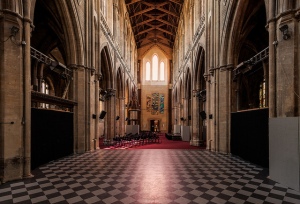
Former sanctuary of the Church of St. Alban the Martyr
“Oh, no, I’m sorry,” she said. “This hasn’t been a church since the 1990s. It now serves as space for our Landmark Arts Centre, which hosts art displays and social dinners and concerts as part of our effort to support local artists.” I discovered in further conversation and research that the original structure, Church of St. Alban the Martyr was built and dedicated to the glory of God in 1889. Though never formally designated a “cathedral,” it became known informally as “The Cathedral of the Thames Valley.” It is indeed a majestic building, reflecting the religious gratitude of multitudes in constructing such a monument to the grace of God.
However, as British society grew more secular and indifferent to things Christian, St. Alban’s disbanded as a congregation in 1977 (only 90 years after the cornerstone had been laid!) and the building was declared “redundant” (don’t you just love British terminology? — it means “superfluous/no longer needed”). Once a glorious edifice, St. Alban’s deteriorated for some 15 years as a derelict building until locals formed a “robust campaign” to see it restored as an English Heritage site in the 1990s. And so today, the Church of St. Alban the Martyr no longer exists, but has been replaced by the Landmarks Art Centre.
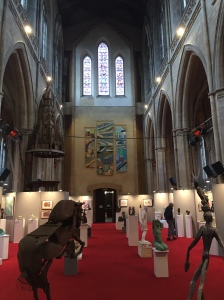
Here’s what the former sanctuary looked like the day I visited in November 2017.
A sad, real-life parable reflecting what has been going on in Western civilization as a whole. The original purpose of the structure has been lost, and it now serves a small enterprise that cannot give meaning to that original architectural masterpiece. A cathedral built for the glory of God now fronts as a warehouse to view paintings and sculptures.
Secular humanism cannot breathe meaning and purpose into a civilization built upon a biblical worldview. It can seek to maintain the structure for a while, as it has in America, but sooner or later the grand architecture of rights and blessings we have enjoyed due to the out-working of the gospel will weigh too heavily on the small enterprise of humanism, and post-Christian civilization will collapse upon itself.
So, can Western civilization defeat Islam? Hardly. It is having a hard enough time standing on its own two feet to resist a secular worldview intent on knocking it over. Certainly, the Western world has enough military power and political resources to restrain the world of Muslim nations and radical jihadi groups, but mere force cannot destroy Islam as an ideology or worldview. Secular humanism is a lightweight against the juggernaut of Islam, which is not just a set of religious beliefs but an all-encompassing worldview, informing the whole of life for its adherents. What is needed to defeat Islam is exactly what the West has jettisoned — an embrace of the worldview of Christianity.
To defeat a strong worldview necessitates an even stronger one. What is stronger than a god of hate if not a God of love? What is better than a god who uses and commands brutal force than a God who exhibits and commands self-sacrifice? What is stronger, a god who harnesses the power of temptation to advance his cause, or a God who defeats the power of sin so as to rescue human beings for a higher calling? What is stronger, a god who promises to reward those who kill and are killed in his name, or a God who conquers death by His own death, in order to offer eternal life as a gift to those who come in gratitude? What is a greater worldview: one that commands love for Muslims and hatred for infidels, or one that commands love for all neighbors, including enemies?
The religion of Islam will one day crumble into oblivion, because it is built upon a worldly spirituality that opposes the true Kingdom of God as revealed in and through Jesus Christ. It will not be other earthly powers that defeat Islam, whether military, political or religious. Only the Church has the message that sounds the death knell of Islam — but it won’t happen primarily by a frontal attack on its tenets and practices. It will come about by the conversions of massive numbers of Muslims who discover that the message of the gospel shines with a light and love and truth which Islam has never been able to match, for all its efforts.
Already, over the last forty years Muslims have been leaving Islam in droves. Many turn first to atheism, thinking that if the “final religion given to man” has proven untenable, then no religion can be true. But thousands upon thousands are being exposed to the gospel for the first time in their lives, and discovering to their irrepressible joy that the Arabian prophet cannot hold a candle to the Son of God.
Can Islam be defeated? Yes, and it will be, but only when the Church wakes up once again to her true Love, and lives out her mission with a passion to love and reach the lost, including 1.6 billion Muslims! If the last forty years are indicative of what God holds for the future, the tide is already turning.

sábado, 1 de junho de 2019

John Rist Sofre Retaliação Terrível


Na época de Bento XVI, os professores em universidades do Vaticano podiam falar mal da doutrina católica e também detonar Bento XVI, hoje em dia só podem falar mal da doutrina.

Professor John Rist, de 83 anos, ilustre católico especialista em ética, autor de inúmeros livros, assinou carta que declarava que Papa Francisco era herético e pedia intervenção dos bispos.

Na semana passada, ele noticiou que recebeu retaliação terrível da universidade augustinianum que é controlada pelo Vaticano. Ele foi impedido de estacionar seu carro e de ser orientador de tese de doutorado de aluno de lá. Ele tem ensinado lá como professor visitante por 15 anos.

Então,  muitos professores estão reagindo a essa atitude totalitária da universidade.

Quem reagiu melhor foi o padre jesuíta, fundador da Ignatius Press, padre Joseph Fessio.

Ele disse:

"The present situation is: a professor in a Catholic institution has freedom to reject authoritative Catholic teaching, but not to criticize the pope. Chesterton would call that topsy-turvydom. I would call it something worse"

Traduzindo:


"A situação atual é: um professor em uma instituição católica tem liberdade para rejeitar o ensinamento católico, mas não para criticar o papa.  Chesterton chamaria isso de turbulento.  Eu chamaria isso de algo pior "


sexta-feira, 31 de maio de 2019

Os Arquivos de Chesterton: De Oxford para Londres (Universidade de Notre Dame)


A Chesterton Library está saindo de Oxford (The Oratory) e indo para Universidade de Notre Dame em Londres. Eu tive o prazer de visitar a Library em Oxford no final de 2017, quando eu fui apresentar um artigo por lá. Foi uma experiência sensacional tocar na máquina de datilografar de Chesterton e ver a extensão dos arquivos de Chesterton.

Vejam o fantástico vídeo acima no qual Aidan Mackey, que conheceu os Chesterton, descreve como foi chamado para cuidar dos arquivos de Chesterton e detalhes sobre Chesterton.

Abaixo vejam algumas fotos que eu tirei durante a minha visita em 2017.

Na oportunidade, eu fui recebido pelo Dr. William Griffiths, e o presenteei com meu livro sobre Guerra Justa.


quinta-feira, 30 de maio de 2019

Cardeal Muller: Papa Francisco Conversa com Lula, mas Não com Salvini.


Ontem, o Brasil acordou com a notícia de que o Papa Francisco enviou uma cartinha para o Lula, um condenado pela maior caso de corrupção da história do país.

Muitos católicos tentaram dizer que a carta era formal, que não era apoio, que Francisco responde a todos que lhe escrevem.

O que não é verdade: a carta não é formal, é amigável (fala até dos entes queridos de Lula), pode ser lida como apoio, pois Francisco diz que a "Salvação vencerá a condenação" (não se diz isso por acaso) e pior, não é verdade que Francisco responde a todos que lhe pedem.

Basta ver os 4 cardeais do Dubia que enviaram carta em 2016 e até hoje não receberam respostas, as dezenas de "apelos filiais" de bispos e leigos enviados ao Papa que ele não respondeu nenhum, e também ao pedido de audiência feito pelo vice-ministro da Itália (Matteo Salvini) que o Papa não recebe. Podemos também lembrar das inúmeras vezes que o Papa atacou o presidente Trump, mesmo antes de Trump se eleger.

Sobre esse último caso, leio que o Cardeal Muller comentou a discrepância de o Papa receber com prazer líderes secularistas e até ditadores como representantes de Maduro e não recebe líderes católicos como Salvini. Além de lembrar que Francisco chegou a dizer que Trump não era cristão.

Vejamos o que disse o cardeal Muller, descrito pelo site The Crux (que um site que procura defender o Papa Francisco)

Cardinal Müller: Francis should engage with populists after election landslide


[A]ccording to German Cardinal Gerhard Müller, former Prefect of the Congregation for the Doctrine of the Faith under Pope Benedict XVI, it’s time for the Italian Church - and Francis - to make peace with Salvini.
“In this moment, the Church is engaged too much in politics and too little in faith,” he told local newspaper Il Corriere della Sera in a May 28 interview.
A Church authority cannot speak in such an amateur way about theological questions and especially it must not intrude in politics, when there is a democratically legitimized parliament and government as there is in Italy,” Müller said.
“It’s better to talk with Salvini, discuss, or correct him when necessary,” he added.
Francis has never officially met with Salvini in person, and even though it’s not required for a pontiff to meet with the Italian leadership, it’s very unusual in a country where the Church and state have usually walked hand-in-hand.
“It’s curious that the pope has received the most secularist people, and not Salvini,” Müller said. “He dialogues with the Venezuelan regime, or with China which places millions of Christians in re-education camps, destroys churches, persecutes Christians.”
“But here in Italy, we’re not in China. You must speak with everyone in a spirit of fraternity,” he said.
Müller criticized what he described as Francis’s “magic circle,” in particular Father Antonio Spadaro, who heads the Jesuit magazine Civiltà Cattolica, and Cardinal Gualtiero Bassetti, who presides over the Italian Bishops’ Conference.
According to the German prelate, calling a baptized and confirmed person not Christian because of their political leanings is “bestial” and the Church “can only warn but not ostracize” when it comes to immigration.
There are countries that wish to de-Christianize Italy and Europe, while Salvini referenced the patrons of the European Union, its Christian roots,” Müller said about the politicians’ Bible-brandishing and saint namedropping antics.
“I prefer those who speak of Christian tradition to those who remove it,” he added.
Müller’s view is reflected in many of the hundreds of people who attended the World Congress of Families that took place in Verona in March or the people who “booed” when Salvini mentioned Francis during a speech before the Cathedral in Milan during the buildup to last weekend’s polls.
Salvini’s oath to “defend life” at a European level, his opposition to LGBT rights, and emphasis on traditional Christian values have caught the attention of the more politically active Catholic factions in Italy.
How long the pope and the Italian bishops will be able to continue their “Cold War” against Salvini is unclear, especially as important ethical debates concerning euthanasia loom over the country. For the time being, Francis’s supporters continue to criticize the Northern League.
“It’s not enough to display the Gospel and the rosary to call yourself a Catholic politician,” said Jesuit Father Francesco Ochetta on the Italian Bishops’ channel Tv2000 May 27.
“For us, the strongest political page in the Gospel is that on the Good Samaritan,” he added.