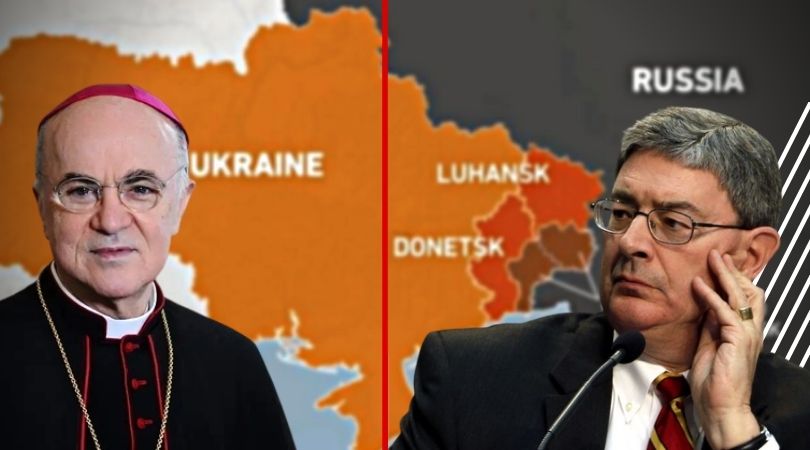
Os defensores de Putin (seja Viganò ou Bolsonaro), entre os conservadores, se apegam a falas de Putin contra a ideologia de gênero ou contra o politicamente correto e nunca sobre a invasão da Ucrânia, nem muito menos sobre o próprio posicionamento de Putin dentro da Rússia, de ditadura opressora de mais de 20 anos, que tem enormes custos sociais, por ele ser parceiro próximo da China e do Irã, muito menos sobre que Putin não luta, por exemplo, contra o aborto ou sobre que ele domina a Igreja Ortodoxa Russa. Sem falar que os defensores de Putin se apegam em uma falácia lógica: geralmente tentam convencer dizendo que se alguém é contra Putin é porque é a favor do Lula, da ONU, do politicamente correto, da ideologia de gênero, do Zelensky, etc. Mas uma coisa não tem nada a ver com a outra.
Hoje, li um artigo do filósofo católico Edward Feser que corrobora tudo que tenho falado aqui sobre o posicionamento do arcebispo de Viganò, em que ele se mostra em apoio a Putin na Guerra da Ucrânia. Eu critiquei o posicionamento de Viganò em dois posts (primeiro aqui, segundo aqui).
O artigo de Feser traz a posição dos pensadores Roberto de Mattei, John Lamont e Pater Waldstein.
O artigo é muito bom realmente, como é usual com Feser.
Leiam abaixo:
Unjust war and false masculinity
I commend to
you three excellent articles by traditionalist Catholic scholars on the grave
injustice of Russia’s invasion of Ukraine: historian Roberto de Mattei’s “Russia's War and the Message of Fatima”; philosopher John Lamont’s “Putin’s Attack on Ukraine”; and theologian Pater Edmund Waldstein’s “The War in Ukraine in the Light of Just War Principles.” There is a reason why I emphasize that the
injustice is grave, as I have in my earlier commentary on the war. Few among those who have expressed sympathy
with the Russian side in the conflict have claimed that the invasion meets just
war criteria (unsurprisingly, since it manifestly does not). They have
tended instead to emphasize Putin’s purported virtues and the vices of Zelensky
and his Western supporters – as if these somehow balance out the destruction of
cities and the deaths of thousands of human beings.
This is
madness. Failure to meet just war criteria is not a mere technical
foible or procedural lapse. An unjust war is among the very greatest
of evils. It is mass murder. Yet some people who rightly
decry the slaughter of the unborn, fret over potential health hazards of
mandatory Covid-19 vaccination, and condemn the economic destruction of
lockdowns can barely muster a disapproving shake of the head for the dead, the
wounded, and the dispossessed of Ukraine. Again, this is madness. What
accounts for it?
We find clues
in the articles linked to – specifically, in what Lamont has to say about
Putin’s false masculinity, in de Mattei’s critique of the oikophobia of Putin’s
Western apologists, and in Waldstein’s remarks about the role of the passions
in people’s reaction to the war. These factors are united in the
delusion that Putin’s actions somehow reflect manful resistance to Western decadence
and apostasy.
To be sure,
there is no question that the West is indeed decadent and largely apostate. There is no question that liberalism
is foolish and feckless at best, and that wokeness is positively wicked and insane. It is nauseating to watch Western
politicians, CEOs, and educators routinely grovel before wokeness’s “smelly
little orthodoxies” (to borrow Orwell’s phrase), rather than doing everything
in their power forever to expunge them from our institutions, root and
branch. It is understandable that decent people would be tempted to
admire a leader who instead treats woke dogma with the contempt it deserves.
But the
temptation must be resisted, and to think that a few traditional-sounding words
and gestures make Putin’s invasion of Ukraine one iota less evil is about as
stark an example of a non sequitur as can be imagined. Nor is it
actually true that he represents a salutary masculine counterpoint to Western
effeminacy. Noting the brutality with which Putin targets civilians
in war, and the violence and manipulation by which he maintains himself in
power, Lamont writes:
This feature
of Putin’s rule should be kept in mind by Catholics and conservatives who see
him as in some way a defender of traditional or Christian
values. Putin’s opposition to gender and LGBT etc. ideology is no
doubt genuine. It is of course not a mark of Christian commitment,
since Hitler, Stalin, and Mao Tse-tung also either opposed these things or
would have opposed them if they had known about them. The nature and
significance of Putin’s opposition to this ideology needs to be
understood. It is the opposition of one evil to the evil at the
opposite extreme from it. Gender ideology denies manhood
entirely. Putin’s actions and ideology spring from an unregenerate
masculinity that is twisted into an evil form, that takes the masculine
characteristics of aggression and assertion and perverts them into an extreme
of brutality and merciless cruelty.
End
quote. If the admiration some Catholics and conservatives have for
Putin is rash, so too is their apparent forsaking of their own
civilization. De Mattei notes how, even when the Western Roman
Empire was steeped in decadence, Christians dutifully rallied to its defense
against more virile barbarian invaders. They did not let the sins of
their homeland blind them to the reality that it was their homeland.
By contrast,
some contemporary traditionalists, rather than fighting for the West against
all enemies, foreign and domestic, seem more inclined to abandon her to the
domestic enemies and root against her in her rivalry with the foreign
ones. But genuine masculinity would eschew such defeatism and oikophobia, in favor of filial loyalty and fighting
spirit. De Mattei writes:
The West is
the firstborn son of the Church, today increasingly disfigured by Revolution,
but still the firstborn. A European who disowns it on the pretext of
fighting the New World Order is like a son who disowns his mother…
In the fifth
century the Goths, the Vandals, and the Huns invaded the Roman Empire to divide
its spoils. Today Russia, China, Turkey, and the Arab world want to
seize the rich heritage of the West, which they consider, as has been said,
“terminally ill.”
Someone may
say: where are you, Stilicho who resisted to the Goths; where are you, Boniface
who defended Africa from the Vandals; where are you, Aetius who defeated the
Huns? Where are you, Christian warriors who took up arms to defend a
world that was dying?
End
quote. Now, apart from the situation in Ukraine, the battles most
contemporary Christians and traditionalists face are not the violent ones our
forebears confronted. They are cultural and political in
nature. Yet, as woke insanity spreads throughout government,
corporations, the military, and universities, as police are defunded and
workers harassed with pointless mandates, the response of some of the people
most impressed by Putin’s purported manliness seems to be a “Benedict Option”
style retreat: “Flee the blue states! Shun the military and the
police force! Run from academia! Quit the
corporations! Don’t even bother to vote, the system is
rigged! These institutions are all rotten; abandon them to the
wokesters!”
Put aside for
the moment the irony that a mass exodus of traditionally-minded people from
these institutions is exactly what the wokesters want. Put
aside the glaringly obvious strategic problem that the more territory you
abandon, the smaller and more vulnerable is any area to which you might
retreat. The salient question for present purposes is: How is this
defeatism manly?
I don’t deny
that the circumstances of some particular individuals and families may require
relocating, seeking new employment, or what have you. But abandoning
institutions to the woke should be the exception rather than the
rule. The rule should be fighting tooth and nail for every square inch
of cultural and political territory. If an institution is lost, it
should never be because it was surrendered. Premature capitulation
is not masculine. And, to echo de Mattei, a true son of the West
will not despair of her and her institutions or flee from them in fear, but
redouble his efforts to reclaim them.
That brings
us to some remarks from Fr. Waldstein’s essay:
The passions
were given us by our Creator to assist us in acting, to help us respond rightly
to the goods and evils that we encounter in this life. The passions
are like powerful horses pulling the chariot of the soul toward
action. But of course, passion is not a sufficient guide to human
action. In order to be good guides to action, passion must be informed
and guided by reason. The virtuous man “is not passion’s
slave.” This does not mean that he lacks passions, but rather that
he feels them in the right way, and toward the right objects, so as to preserve
the true good apprehended by reason. Reason is like the charioteer
who controls the horses of the passions with reigns and whip, so that they draw
the chariot in the right direction, and at the right speed, so that it does not
capsize at a corner.
There is a
danger in human life of being swept along by passion beyond the measure of
reason. This is danger is certainly strong in war time.
End
quote. Now, there are certainly some on the anti-Putin side who have
let passion cloud their reason – most especially, those eager for NATO to enter
the war, which, as Fr. Waldstein argues (and as I have argued too), would violate just war criteria no less surely
than Putin’s invasion does. And some of this fanaticism is clearly
motivated by grievances having nothing to do with Ukraine, such as rage at
Putin’s anti-LGBT policies and the delusion that the Russians somehow tipped
the 2016 U.S. presidential election against Clinton.
But the
faults of some of Putin’s critics simply don’t make his invasion of Ukraine any
less evil. And those who pretend otherwise have also let
passion cloud their reason. If downplaying the gravity of Putin’s
crime as a way to “own the libs” has appeal for some, that appeal can only be
emotional rather than rational. Needless to say, that too hardly
fits any stereotype of masculinity.
At the end of
the day, even genuine masculine fortitude and sobriety can only ever be an
instrumental cause. From a Catholic point of view, the true solution
to the crisis of our age must come from above – from (to give de Mattei the
last word) “the triumph of [Our Lady’s] Immaculate Heart over the rubble of the
Putin regime, the Chinese communist regime, the Islamic regimes, and those of
the corrupt West. Only she can do it; of us she asks an unshakable
trust that this will happen, because She has infallibly promised
it. This is why our resistance
continues.”